



.svg)


.svg)
.svg)
.svg)
.svg)
.png)
.jpeg)
Great real estate pitches aren’t about slick one-liners or building a “sense of urgency.” The true strength of a pitch comes down to two simple things: relevance and value.
And in a crowded real estate industry, only a tight sales pitch cuts through.
In 2026, buyers and sellers have more reasons to feel confident working with an agent. But that doesn’t mean you can sit back and let the market carry you. Treat your pitch like a core asset of your real estate business. Refine it, test it, and align it with the market.
With a library of reliable real estate scripts, pitches and objection handlers, you can stand out among a sea of competitors who don’t know what to say.
Use these real estate pitch examples to coach agents to diagnose needs quicker and establish trust faster.
How to write an effective sales pitch:
- Lead with one outcome
- Quantify value
- Offer proof via success stories
- Keep it to 30 seconds
- Make it specific
- Close with a single CTA
Why a dialed-in sales pitch matters more than ever
If hitting your transaction goals feels like pushing uphill, we’re happy to tell you the terrain is leveling out.
According to recent market predictions, 2026 is the year most major markets stabilize. Buyers get a break from the pressure of rising interest rates and sellers reap the benefits of steady demand. Stay current on the latest trends so you can tailor your advice to reflect the real market buyers and sellers are experiencing.
The latest data shows home sales on track to surpass 4 million, roughly a 4.3% increase from last year. After a stretch of high mortgage rates and limited inventory, pent-up demand is finally unlocking. That means more opportunities for agents who know how to position their value.
“2026 will be a window for buyers who want stability, not a bidding war circus,” says Kara Ng, Senior Economist at Zillow. “Sellers can list knowing prices are more likely to inch up than roll over.”
Zillow data showed a 5% increase in new listings and pending sales last October, a notable increase from the usual seasonal slowdowns.
For ambitious agents, healthier volume and steadier pricing mean more conversations you can win—but only if your pitch is dialed in.
Real estate elevator pitch examples and how to write one
As the market shifts, so too should your value prop. As a general rule, real estate professionals should revisit their wording quarterly to make sure they still reflect the right market trends and client priorities.
Make it short, snappy and easy to turn on at a moment’s notice by practicing your value prop as a 30-second elevator pitch. Here’s where to start.
Lead with a clear outcome
Tell your potential client in one sentence how you’ll save money, save time, or increase certainty. Pick one primary benefit so it lands. Speak to specific needs rather than a generic promise.
🔹 Example: “I help first‑time buyers cut their monthly payment by pairing the right home with the best builder incentives.”
Quantify the value
Use specific numbers or proof points (average days to contract, typical negotiation savings, list‑to‑sale ratio, number of transactions). Think in terms of metrics you can show in a listing presentation or on your LinkedIn profile.
🔹 Example: “Over 200 closings, my buyers average 1.2% off asking, plus $4,800 in seller credits.”
Show likelihood of success
Anchor your credibility in relevant experience, a repeatable sales process, or local expertise. Add one line that references success stories or a client referral to reinforce trust.
🔹 Example: “In 12 years, our 3‑step pricing plan has sold 87% of listings in under 14 days in Hyde Park.”
Keep it short
Aim for 20–30 seconds: one promise, two quick proof points, one CTA. Close with your contact information so there’s zero friction to respond.
🔹 Example: “I help sellers net more with a two‑week launch. Last year 84% went under contract in 14 days. We can do a free pricing walk‑through at 4:30 or 6:00?”
Make it situational
Tailor to buyer vs. seller, new construction vs. resale, and their timeline.
🔹 Example: “If you’re planning for spring, I’ll compare builder buydowns so your net payment beats resale. Want two model tours this week?”
{{cta-blue}}
End with one clear call to action
Offer two choices for an appointment or call time and ask for the yes.
🔹 Example: “I can show you two top fits Tuesday at 5:00 or Wednesday at 6:30—which works?”
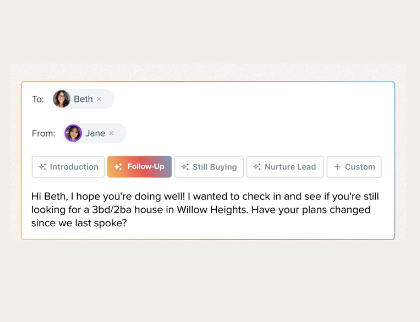
More personalization, less busywork. AI-powered Smart Messages suggest the right reply so you can respond faster and still sound like you. Learn more.
How to write your elevator pitch (mini template for agents)
Dale Archdekin, founder of Smart Sales Coaching, has worked with hundreds of agents and ISAs on perfecting the art of the real estate sales pitch.
His advice? Don’t get bogged down by irrelevant details. It’s about connection, not perfection.
“You need to have some of these elements, you don't have to get all of them—that's not the game here,” he explains. “We need to know, are you going to save them money? Are you going to save them time? Can you put in some sort of likelihood of success?”
To start, take this mini template for a spin:
- Promise: “I help [buyer/seller type] [save money/save time/gain certainty] by [negotiation method/marketing strategy/etc].”
- Proof: “In [X years/X deals], clients typically [result], because we [process].”
- CTA: “I can [next step] today at [time A] or [time B]—which works?”
Whether you’re coaching yourself or the agents on your team, the following questions can help crystallize your pitch:
- What are we promising? Money, time, or success? Pick one.
- What proof can we offer in one line? (Years, Deals, Ratios, Process)
- What’s the next step we want? What two options will we offer?
- Can we deliver this in under 30 seconds without losing clarity?
The point of an elevator pitch isn’t to memorize and regurgitate a specific set of talking points.
The goal is to help you build sales “muscle memory.” The more reps you get, the easier it will be to avoid filler, replace hype with specifics, and get to know the prospect's real pain points.
Remember, you don’t have to hit every single selling point on the list. Stay focused and stick to what’s most relevant to each person you’re talking to.
{{cta-yellow}}
7 sales pitch templates to try with your agents
Even in a stable market, most unknown calls go unanswered. Every conversation has to count.
Practice these sales pitch templates to hold your prospect’s attention, speak directly to their pain points, and build trust faster. Tailor your pitch to your market, then keep roleplaying, recording and reviewing until you find what works.
1. Inbound showing request—book tentatively, then qualify
Whether you’re talking to a first-time homebuyer or third-time investor, the number one goal for every potential client is to get a date on the calendar.
Sample pitch: “I help buyers cut monthly payments and avoid overpaying through timing, home selection, and negotiation. Over 200 closings, my clients average 1.2% off ask plus seller credits. I can line up two fits and a payment compare at 4:30 or 6:00. Which is the better time?”
This example would be great to roleplay, but be ready to personalize your pitch for those with a longer timeline. And always keep your eye on the ball.
Here are some conversation starters to help you structure your approach:
- Offer: “Great—2:00 works. I’ll check with the sellers to confirm. If that doesn’t work, what other times this week are good for you?”
- Ask: “Are you planning on buying in the next few months or just window shopping?” “How long have you been looking?” “What’s important about moving by [date]?”
- CTA: “Since you said you’re window shopping, let’s see two places so you can feel what your dollar actually buys—pictures aren’t the same as walking a home.”
📌 Pitching pro tip: Use “buy” (not “move”) to clarify intent. And always add warmth early. For example, start with a softball like: “First‑time buyer or current owner?” Then get them talking about themselves.
🏅 Coaching insight: Rates are unlikely to dip below 6% in 2026. Consider steering buyers away from waiting and toward what they can control: smart timing, the right home choice, and strong negotiation.
⚙️ Systems play: Make sure callers always reach the right person. Set up your CRM to route known clients to their assigned agent, send new leads to a shared ring group, and log missed calls to a team inbox for fast follow‑up.
2. New construction buyers—net pay vs. sticker price
Single-family starts are set to be the slowest since 2019, as builders focus on selling existing inventory. Data shows that nearly two-thirds of them are now offering incentives in addition to price cuts.
This is great news for potential buyers, but it also means there’s a lot more to consider (rate buydowns, closing-cost credits, upgrades). Coach buyers to weigh the full package, not just price.
Sample pitch: “I help new‑construction buyers lower their actual monthly payment by stacking builder incentives with the right lender programs—so the net beats resale even when the base price looks higher. In the last 30+ new‑build closings, my clients averaged $8,500 in credits and a temporary buydown that cut payments by about $200/month. I’ll line up two model tours and a side‑by‑side payment comparison at 4:30 or 6:00—what’s better for you?”
Here’s how to structure your discovery:
- Ask: “Are you focused on builder incentives or base price?” “What monthly payment target do you want to hit?”
- Pitch: “Builders are leaning on buydowns and closing‑cost help—let’s compare net monthly payments across three communities.”
- CTA: “I’ll line up two model tours and a quick side‑by‑side of incentives. Is afternoon or evening better?”
📌 Pitching pro tip: Encourage new build buyers to shop incentives and net payment—not just price.
🏅 Coaching insight: Keep the focus on net payment and timeline. Avoid volunteer disclosures (e.g., internal builder constraints) that don’t help them decide.
⚙️ Systems play: After a tour, trigger a recap sequence—photos, payment comparison PDF, incentive summary, and a yes/no CTA for next‑step selection (Community A, B, or expand search).
3. Lifestyle renters and budget‑first buyers
Not every renter is eager to sprint into ownership. Validate the choice to rent for flexibility, then reframe the decision.
Sample pitch: “If you’ll be here 3+ years, let’s run your real rent against an ownership payment. In a lot of cases, the gap is under $200/month and you gain stability while building equity. You don’t need 20% down, there are 3–5% options and grants. I’ll do a side‑by‑side with your actual numbers and show two homes at that payment. I have 4:30 or 6:00—what works?”
Run a simple rent‑vs‑own analysis. When you tally rent hikes, fees, and move risk, the “extras” that come with renting could land close to the hidden costs of owning.
Start here with renters and budget buyers:
- Ask: “Besides the down payment, is there any other reason you wouldn’t want to buy?” “What can you comfortably afford monthly?”
- Pitch: “You’re about to pay rent—let’s match that to financing options. Many programs aren’t 20% down (FHA 3.5%, USDA 0% eligible areas, assistance/grants).”
- CTA: “Want a 10‑minute call with a lender to map monthly payment scenarios against your rent?”
📌 Pitch pro tip: Frame stability: “If you’re not moving soon, owning gives you more control over monthly payments, less year‑to‑year uncertainty, and equity over time.”
🏅 Coaching insight: Don’t treat “no down payment” as final. Coach agents to isolate the objection and educate. Use the window‑shopping close to get them into two homes.
⚙️ Systems play: Add a lease-end date field to lead profiles. Trigger reminders and automated nurture touches 90/60/30 days before expiration.
4. Book the listing, then diagnose
As prices stabilize, more homeowners can afford to list without risking prior gains. Again, your job is to book the appointment immediately. Then, structure your conversation to uncover any factors that could cost you the listing (think: competition, price expectations, timing, neighborhood requirements).
That’s where a value-driven pitch comes in.
Sample pitch: “I help sellers price to the market and protect momentum with a 2-week launch plan. In the past year, 84% of my listings went under contract in 14 days. Want a 20-minute pricing and net sheet walkthrough today or tomorrow?”
Working with a team of real estate ISAs? Make sure they’re ready for every conversation with these top qualification and risk control tips from Dale:
- If they’re interviewing others: “Have you already met with anyone? What stood out, so I can tailor what matters most to you.”
- Price reality check without losing credibility: “Do you have a target number, or should I recommend one based on recent sales?”
- Neighborhood specialist: “I’ll connect you with an agent who specializes in your area so you get accurate local pricing and buyer trends.”
📌 Pitching pro tip: If property‑specific buyer agency or listing agreements are standard, position a “test drive” followed by a longer mutual commitment with a zero‑cancellation clause if you don’t perform.
🏅 Coaching insight: Role‑play competing against a named agent. Rehearse how you’ll differentiate your sales pitch—marketing strategy, communication cadence, net outcomes, etc.—without speaking negatively about the competition.
⚙️ Systems play: Offer two times by phone, then drop a confirmation and calendar invite, schedule automated reminder texts to reduce no-shows.
5. Reviving expired listings
Expireds are skeptical. And can you blame them? They’re fielding a flood of outreach every day.
Your job isn’t to diagnose the last agent—it’s to reset momentum and prove you can control the process. Book the appointment first, then lead with focused energy, clear questions, and one concise differentiator that speaks to results.
Sample pitch: “I relaunch expired listings with pro media, pricing tune-up, and weekly reporting so you’re never guessing. Last quarter, 7 of 9 expireds sold within 21 days. I can meet Tuesday at 4:30 or Wednesday at 9:00—what works?”
This pitch acknowledges the miss without blame, offers a repeatable relaunch plan, and promises a specific communication cadence. You’re pairing proof (recent outcomes) with a near-term next step to re‑establish control.
This simple structure can help:
- Ask: “When would you like your property back on the market?” “What changed since the last listing—any feedback from showings, pricing, marketing, communication?”
- Offer: “I don’t know what your last agent did; I do know you didn’t get the result you wanted. We’ll bring a 2‑week relaunch: pro photos, pricing tune‑up, targeted marketing, and weekly reporting.”
- CTA: “I can meet Tuesday 4:30 or Wednesday 9:00.”
📌 Pitching pro tip: If challenged (“What makes you any better than the last agent?”), pivot: “You didn’t get the result you wanted—what result are you looking for this time?”
🏅 Coaching insight: Role‑play high‑pressure expired scenarios. Practice isolating the objection, handling price reality (see #7 for more help there), and trial‑closing for the appointment. Record and review calls, asking: “Would I keep talking to me?”
⚙️ Systems play: Tag competitive situations in your CRM. Use Call Summaries to recap objections and update your expired listing scripts based on what works.
6. ‘FSBO helper’ pitch
FSBOs are inundated and protective of control. Your job is to offer leverage without taking the wheel. Book the appointment first, then lead with a value prop that removes pain (screening calls, showings, negotiation, paperwork) while keeping them in charge.
Sample pitch: “The way I work is you keep control, I add leverage. I’ll screen inquiries, handle showings, negotiate terms, and manage contracts and disclosures so you avoid the headaches. If we bring the buyer, are you open to a 3% buyer‑agent commission? I can stop by Wednesday at 5:30 or Thursday at 9:00 to outline options?”
Make sure your pitch respects their decision to sell themselves, clarifies your fees transparently, and offers a concrete menu of help.
Here are some additional conversation starters you can try:
- Ask: “When are you starting showings?” “How long will you try, and what’s plan B if it doesn’t sell?” “What’s most important—price, speed, or simplicity?”
- Offer: “We can ‘sell‑with‑you’ (screening, showings, negotiation, paperwork/compliance) or ‘paperwork‑only’ for a simple fee—subject to state rules. I’ll also run low‑cost ads and set up an info line so your phone doesn’t blow up.”
- CTA: “I’ll stop by for a 15‑minute walkthrough and outline the plan. Wednesday 5:30 or Thursday 9:00?”
📌 Pitching pro tip: If challenged, dig deeper: “What result matters most so I can tailor the plan?”
🏅 Coaching insight: Role‑play both intro paths (buyer pipeline vs. partnership), practice commission language (“standard 3%”), and rehearse your three core questions (why FSBO, duration, plan B).
⚙️ Systems play: Create an FSBO-specific pipeline and Smart List. Use filters like “FSBO + next 14 days + no appointment” to keep the team focused.
{{cta-blue}}
7. Price adjustment conversation
When activity stalls, your job is to protect momentum and reset to market reality. Book the alignment conversation first, then lead with fresh comps, buyer behavior, and clear options. No arm‑twisting, just data and outcomes.
Sample conversation starter: “Showings have dipped, which tells us buyers aren’t seeing the value at the current price. I’ve modeled three scenarios with expected activity and net—one small reduction to spike showings, one to catch the next buyer band, and one strategic hold with a marketing tweak. I can walk you through them today at 4:30 or 6:00—what’s better?”
Reframe the conversation around buyer signals and net outcomes. Give options (not ultimatums):
- Ask: “Do you want to attract more showings or hold for a specific net?” “What feedback have you heard from showings?” “Has anything changed—timeline, competing listings, condition?”
- Offer: “Here are three data‑backed pricing paths with expected showings, offers, and net. We’ll pick the one that best matches your goal.”
- CTA: “Let’s choose a scenario today and update by noon tomorrow. I have 4:30 or 6:00 to review—which works?”
📌 Pitching pro tip: Anchor recommendations to buyer behavior (days on market bands, price‑point drop‑offs, comp trajectories) rather than your opinion.
🏅 Coaching insight: Practice objection handling (“We can just wait,” “The right buyer will come”) with tight, data‑first language. Role‑play delivering options and securing the decision in one call.
⚙️ Systems play: Send regular market updates via video, email newsletters and/or a weekly one‑pager. Cover activity vs. expectations by scenario, recommended next micro‑move (showing event, incentive, minor condition fix).
Practical ways to sharpen your pitch and win the next step
Value comes from context, good questions, and one clear next step. Keep it simple and repeatable.
Prepare with context
Open with 2–3 clarifying questions to surface the potential clients’ real pain points (money/time/certainty).
Talking with a known contact? Start with signals: skim lead source, notes, tags, and recent site activity so you’re not asking what you should already know.
Confirm anything that’s changed since your last touch so that your advice maps to the current reality, not yesterday’s.
Personalize the value
Specific beats generic every time. Anchor your pitch in what they’ve shown interest in.
Reference a specific property, neighborhood, or behavior, then deliver a value (two home showings, a 5‑minute market update, net sheet, etc).
Offer proof
Use one line of credibility so the prospect knows you’ve done this before. Tie that proof directly to their stated goal (saving money, saving time, or increasing certainty) and move forward.
Proof should be short and verifiable: years, deals, ratios, proven and repeatable sales processes. If it feels organic, add links to agent reviews, case studies and testimonials in your next email to the potential client.
Set and confirm one next step
Win a small “yes” with two clear options (tour times, call slots, plan choices) and lock it in while momentum is high.
Attach the deliverable and confirm by text or email immediately to reinforce your value and prevent no‑shows.
Follow through and improve
Context compounds across touches. Log outcomes, objections and decisions right away so that anyone on your team can lead a value-first call, even if a lead raises their hand while you’re on vacation.
Record calls and structure your coaching around what actually happened, not what you hoped happened. Test and iterate your real estate scripts based on real conversations and patterns.
{{cta-yellow}}
Don’t expect black and white
“Most of them are curveballs. If you want to do more deals, you’ve got to figure out how to knock the dust off,” says Dale.
Open with questions that surface real goals, constraints and timing so your advice is relevant:
- “What’s the main goal—price, speed or simplicity?”
- “What’s the one must‑have that would make this a yes?”
- “What’s your timing and what could change it?”
His approach is simple: “Don’t just take it at face value. Go over the facts again. Make sure you agree with every piece of information that went into that decision making. ”
Context matters. When AI learns from your actual day-to-day operations, it delivers substance—not empty promises. Explore Follow Up Boss’s AI features with a free 14-day trial.
Close strong with context
For greater success at the team level, coach every agent to anchor their sales pitch in real conversations—not canned lines. When you lead with relevance, proof, and one clear next step, you earn trust and momentum.
Follow Up Boss helps you deliver a personalized pitch at scale with AI features that surface what matters in every interaction. With AI that works where you do, you can coach better and act faster.
Make every touchpoint specific, fast, and on-brand—without extra work. Use AI in your existing workflow in Follow Up Boss and coach from real data. Get your 14-day free trial.
FAQs
What makes a strong real estate elevator pitch?
Keep it under 30 seconds with one clear promise (money, time, or certainty), two concise proof points (years, deals, ratios, process), and a single CTA offering two options.
How should I tailor my pitch for new construction vs. resale?
Focus on net monthly payment and incentives for new builds (rate buydowns, closing‑cost credits, upgrades). Do a side‑by‑side against resale so buyers see the true payment, not just sticker price, and align the plan to their timeline.
What’s the best way to lock in an appointment on an inbound call?
Book it first (even tentatively) by offering two specific times, then qualify. Use “buy” (not “move”) to clarify intent, ask timeline and motivation questions, and keep the CTA simple—two showings plus a quick payment comparison.
.webp)
.png)

%20(1)%20(1).png)